
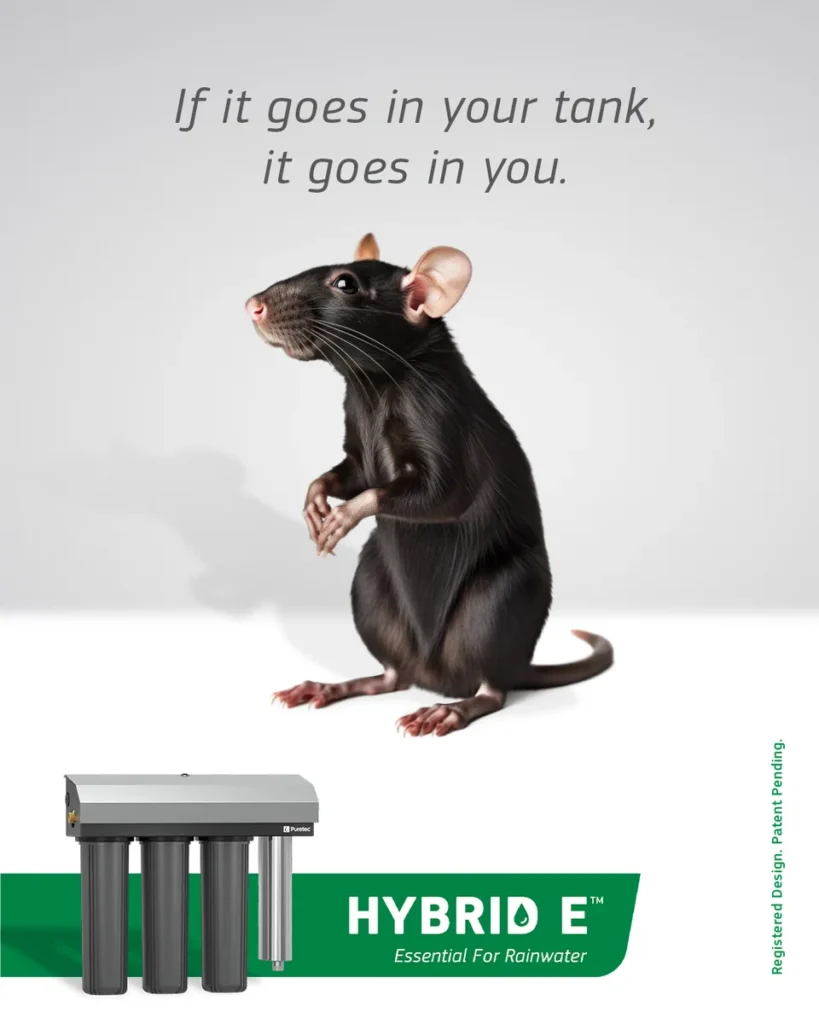
There are two main ways Puretec systems treat microbiological contaminants: Radfire™ ultraviolet (UV), which Puretec states kills up to 99.9% or 99.99% of bacteria depending on the model, including E. coli, Giardia and Cryptosporidium cysts; and ultrafine Ultra Z filtration down to 0.1 micron (nominal), which protects against cysts and bacteria such as E. coli at a single tap. For Cryptosporidium, Puretec says a whole-house system is the primary choice because it treats every tap and the shower.
Why these contaminants matter
Puretec explains that rain, surface and bore water can easily become contaminated, and surface and bore water so easily that bacteria treatment becomes critical. Cryptosporidium is a microscopic parasite protected by an outer shell, which makes it tolerant to chlorine disinfection – so even chlorine-treated mains water can be affected during an outbreak. For health concerns or symptoms, contact your doctor or state health department.
UV treatment (Radfire™)
UV treats water without chemicals. Puretec’s systems filter the water first, then pass it through a UV chamber:
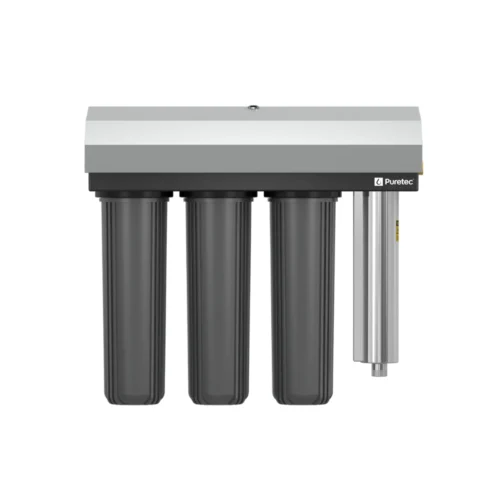
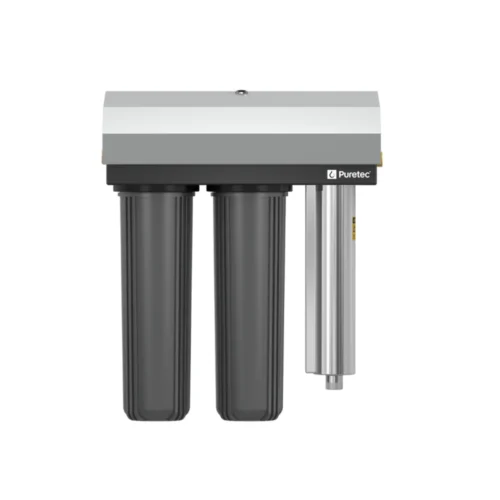
- Hybrid E13 and Hybrid E7 – whole-house filtration and UV; Puretec states they kill up to 99.99% of E. coli, Giardia, bacteria and Cryptosporidium cysts. Puretec quotes the E13 at up to 120 Lpm at 40 mJ/cm².
- WU-UV150 – an indoor whole-house filtration and UV system for mains or rainwater.
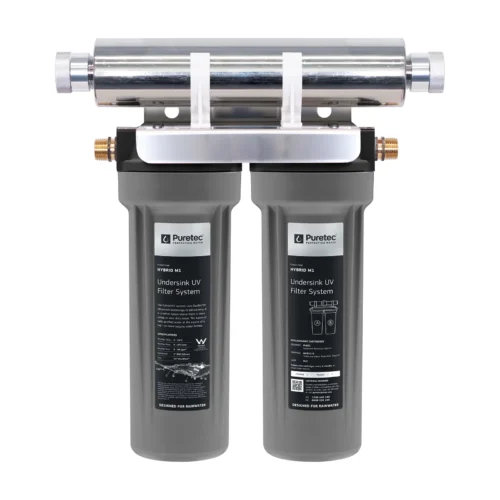
- Hybrid M1 – under-sink filtration and UV for one tap, killing up to 99.9% of bacteria; up to 8 Lpm at 30 mJ/cm², which Puretec describes as the industry standard dose for drinking water.
Ultrafine filtration (Ultra Z)
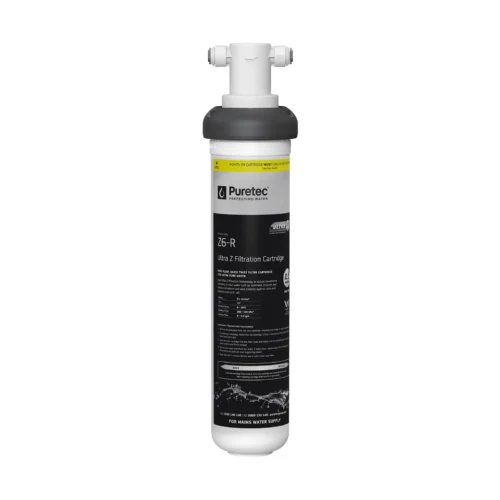
The PureMix Z6 filters down to 0.1 micron (nominal), including Giardia and Cryptosporidium cysts, and protects against bacteria such as E. coli, at up to 9.5 Lpm. Puretec’s Z1-R cartridge, used in Z1 systems at up to 5.5 Lpm, is rated for 99.9% reduction of Giardia and Cryptosporidium cysts.
Whole house or single tap?
Puretec notes that point-of-use systems have excellent filtration capacity but protect only one point of use. For Cryptosporidium treatment you would need a system for each household tap, it would not protect shower water, and cross-contamination between hot and cold lines needs to be considered. Because the parasite can survive outside the body, Puretec stresses treating all water used in the home – drinking, food preparation, showering and brushing teeth.
Limits to keep in mind
- UV treatment assumes the water remains clear and flow rates do not exceed the maximum at the specified UV dose.
- Iron prevents UV sterilisation from working, so bore water with iron needs treating first.
- For surface or bore water, Puretec requires a water test before purchase.
- Maintenance: Puretec says Hybrid E maintenance includes replacing the UV lamp once a year and periodically cleaning the sleeve.
Installation: connection to your water supply must be carried out by a licensed plumber, and any hard-wired electrical work by a licensed electrician.
Recommended products
- Puretec Hybrid E13 – whole-house triple-stage filtration and UV, up to 120 Lpm at 40 mJ/cm².
- Puretec Hybrid E7 – whole-house dual-stage filtration and UV for larger homes.
- Puretec WU-UV150 – indoor whole-house filtration and UV system for mains or rainwater.
- Puretec Hybrid M1 – single-tap UV and filtration that connects to your existing mixer tap.
- Puretec PureMix Z6 – single-tap 0.1 micron (nominal) ultrafiltration for mains water.
Puretec Hybrid E13 E Series
Original price was: $4,099.67.$3,399.00Current price is: $3,399.00. inc GST Add to cartPuretec Hybrid E7 E Series
Original price was: $3,425.72.$2,729.00Current price is: $2,729.00. inc GST Add to cartPuretec Wu-UV150 Whole House UV & Filtration System
Original price was: $1,580.87.$1,328.00Current price is: $1,328.00. inc GST Add to cartPuretec Hybrid M1 Under Sink Dual Stage Filtration With UV Technology, 1 Micron
Original price was: $1,247.64.$999.00Current price is: $999.00. inc GST Add to cartPuretec Puremix Z6 Premium High Flow Under Sink In-Line Filter
Original price was: $496.71.$439.00Current price is: $439.00. inc GST Add to cart

Frequently asked questions
Does chlorine in mains water kill Cryptosporidium?
Puretec explains that Cryptosporidium is protected by an outer shell that makes it tolerant to chlorine disinfection, which is why outbreaks can occur even in chlorine-treated mains water.
Is UV enough on its own?
Puretec’s UV systems filter the water first, because UV treatment assumes the water remains clear and flow rates stay within the maximum at the specified UV dose. Iron also stops UV from working properly.
Can an under-sink filter protect my whole house?
No. Puretec notes point-of-use systems protect a single tap only and do not protect shower water. A whole-house system is its primary choice for Cryptosporidium.
How often should a UV lamp be replaced?
For its Hybrid E systems, Puretec says to replace the UV lamp once a year and periodically clean the quartz sleeve.
Related guides: Boil water alerts, Is rainwater tank water safe to drink?, Under-sink vs whole-house filters.
Questions? Call or text 0447 203 775 or email [email protected] and we will help you choose.